
| Subfamily | Ornithoctoninae |
| Origin | Myanmar, Thailand |
| Popularname | Cobolt blue |
| Size | ca 6cm body, ca 15cm legspan |
| Temperature | 27-28c |
Introduction
Cyriopagopus contains some of the more defensive theraphosids, generally speaking. C. lividus can be found in southern Myanmar and overlapping the border to Thailand and several other members of the genus are scattered across South East Asia.
In the terrarium
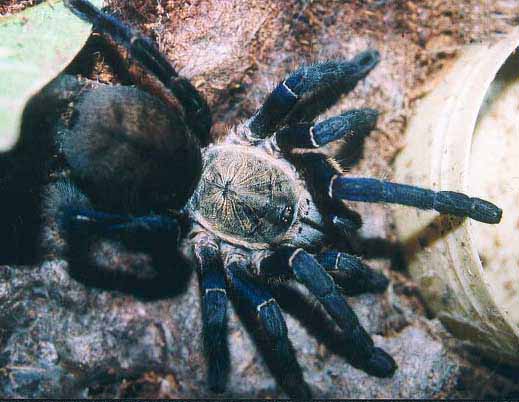
This spider are easily recognized by the steel blue color that almost glows when the spider are freshly molted. A very beautiful spider that attracts many, however lividus are not a good spider for the beginner.
A standard terrarium measuring 30x30x30cm is perfect for this spider. The bottom substrate should be thick enough to allow the tarantula to burrow. Moist peat, unchalced and unfertilized, are perfect. After introducing the spider in the cage it doesn’t take long before it start to burrow. Sometimes, especially wild caught spider, can take a day or two to start creating a burrow so put a piece of cork in there for the spider to hide under. Some wild caught Cyriopagopus dont take captive environment so good – another reason to avoid WC. Place a water bowl in the cage and decorate with plants if you like but its not necessary. Keep a high humidity with misting once a day, and keep the temperature around 27-28c. Try find captive bred specimens from a breeder. Juveniles don’t look the same as adults – they lack the blue coloration and the blue color will appear stronger by each molt. The males looks the same as females until after the last molt, when they get a overall brown color.
Food
Give the spider insects such as crickets, cockroaches and grasshoppers. The size and amount are adjusted to the spiders size. Lividus spend the daytime down in its burrow and emerge after dark. Feed it when you see its legs sticking out from the entrance of the burrow. Feed adults 1-2 times a week, spiderlings 3-4 times a week. This species grows at medium rate with males reach maturity in 2 years, females a year later. This also depends on food supply and temperature.
Handling
Most are quite defensive, so picking it up with your hands are not a good idea. When transfer these spiders use a plastic box.
References
Smith, A. M. (1996)
A new species of Haplopelma (Araneae: Theraphosidae), with notes on two close relatives.
Mygalomorph 1:21-32.